Various types of cars are available in Nepal, making it confusing for users to choose the best-fitting one for their interests and needs. It is not only about the budget but also about the fuel usability, road conditions, taxes, maintenance costs, parts availability, and long-term ownership.
Car choices range from diesel to petrol, hybrid, and electric. Understanding these cars will make it easy to identify the right type best suited for city roads, hilly areas, or family use. So, here’s the complete guide to the different types of cars available in Nepal, along with their advantages and disadvantages.
Types of Cars by Fuel
One of the first decisions when buying a car is choosing the fuel type. These are the types of cars in Nepal that are commonly used. Petrol, Diesel, Hybrid, and Electric are some of the fuel types available in Nepal. Each one has its significance, especially here in Nepal, where road conditions and fuel costs vary.
Petrol Cars
Petrol cars are the most common type of passenger vehicle in Nepal. They use petrol fuel and internal combustion engines. They are mostly ideal for city driving, where short trips and stop-and-go traffic are common.
Advantages
- Lower initial cost to buy
- Smooth and quiet engine
- Easy maintenance
- Suitable for city driving
- Easy availability of spare parts
Disadvantages
- Petrol is more expensive than diesel per litre
- Low mileage compared to diesel cars
Diesel Cars
Diesel cars are the second most common among initial users after petrol cars. They utilize compression-ignition engines and are recognized for their higher torque output. These cars are mostly well-suited for highway and long-distance travel.
Advantages
- Fuel-efficient for long distances
- Durable engine
- Strong pulling power in hills
- Suitable for highway driving
Disadvantages
- Higher maintenance cost
- Noisier engine
Hybrid Cars
Hybrid cars combine a petrol engine with an electric motor to reduce fuel consumption. They are eco-friendly and improve efficiency, but are less common in Nepal.
Advantages
- Better fuel efficiency
- No need for external charging
- Better for the environment
- Smooth driving experience
Disadvantages
- Initial price is higher
- Low availability
- Limited service centers
- Complex system
Electric Cars
Electric Cars run entirely on electricity, battery power, and electric motors. EVs are the future of transportation. Electric cars are mainly suitable for cities in Nepal, due to the growing number of charging stations and government incentives.
Advantages
- Low running cost
- Eco-friendly
- Minimal maintenance
- Favourable tax treatment
Disadvantages
- Higher initial price
- Limited charging stations
Types of Cars by Body Style
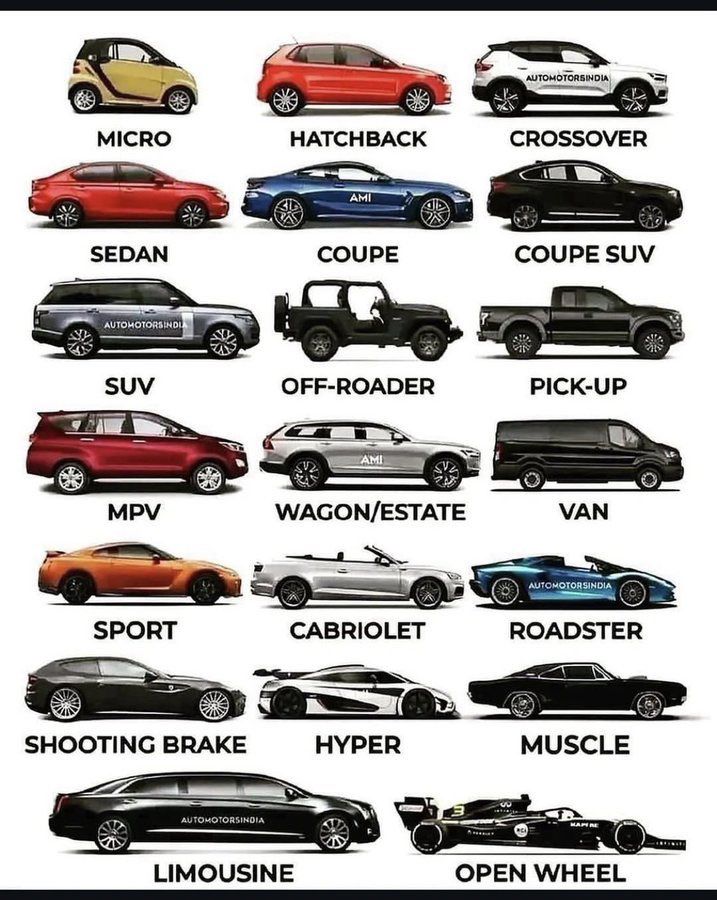
Types of cars in Nepal are further classified by body style. It determines space, comfort, and suitability for different road conditions in Nepal. Commonly used cars are Hatchbacks, Sedans, SUVs, and Minivans.
Hatchbacks
Hatchbacks are small cars suitable for a small family. They have rear doors that open upwards, well-suited in a city like Kathmandu with narrow roads.
Advantages
- Easy to park
- Fuel efficient
- Affordable
- Compact and easy to maneuver
Disadvantages
- Not Ideal for rough roads
- Space not enough for luggages
Sedans
Sedans are highly popular cars in Nepal. They are slightly bigger than hatchbacks and have a separate trunk for luggage. The popularity of sedans is directly related to their comfort for long drives.
Advantages
- Fuel-efficiency
- Comfortable seat
- Affordable
Disadvantages
- Lower ground clearance, not ideal for hilly or rough roads
SUVs
Sport Utility Vehicles are larger vehicles. They have higher ground clearance in hilly terrain and rough roads, making them popular in Nepal.
Advantages
- Durable and Reliable
- Handle rough roads easily
- Spacious
Disadvantages
- Higher fuel consumption
- Expensive
- High maintenance
Minivans
Multi-purpose vehicles (MPVs) or minivans are designed to carry large numbers of passengers. They are ideal for big families or commercial purposes.
Advantages
- Large seating capacity
- Ideal for long-trips
Disadvantages
- Higher fuel consumption
- Expensive
Cost Comparison Among Different Types of Cars in Nepal
| Car Type | Purchase Cost | Running Cost | Estimated Annual Running Cost (NPR) | Maintenance Cost | Ease of Servicing in Nepal | Resale Value |
|---|---|---|---|---|---|---|
| Petrol | Low | Medium | NPR 120,000 – 180,000 | Medium | High | Medium |
| Diesel | Medium | Low | NPR 100,000 – 160,000 | Medium-High | Medium | High |
| Hybrid | High | Low-Medium | NPR 90,000 – 150,000 | Medium | Low-Medium | Medium |
| Electric | High | Very Low | NPR 40,000 – 80,000 | Low | Low | Medium |
| Hatchback | Low | Low | NPR 90,000 – 140,000 | Low | High | Medium |
| Sedan | Medium | Medium | NPR 120,000 – 180,000 | Medium | High | Medium |
| SUV | High | High | NPR 160,000 – 250,000 | Medium-High | Medium | High |
| MPV/Minivan | High | Medium | NPR 140,00 – 220,000 | Medium | Medium | Medium |
Types of Cars Suitable for Nepal Roads
Driving in Nepal roads includes some conditions, such as heavy traffic, uneven surfaces, steep hills, and monsoon-related challenges. So, different types of cars are compatible with various road conditions and usage.
- Petrol cars: Good for city use
- Diesel cars: Better for highways and hills
- Hybrid cars: Balanced urban use
- Electric cars: Best for predictable daily travel
- Hatchbacks and small sedans: Perfect for navigating traffic and narrow streets.
- Sedans and SUVs: Comfortable for long trips and highway driving.
- SUVs and Pickups: Easy for hilly, uneven roads and steep climbs.
- Sedans, MPVs, and SUVs: Enough space and comfortable for family use.
Common Myths About Types of Cars in Nepal
Diesel cars are banned in Nepal: Not true, but regulations are tightening.
Electric cars cannot climb hills: Modern EVs handle hills efficiently.
Hybrids do not save fuel: They significantly reduce fuel consumption in traffic.
Diesel cars should be run at least 50 kms daily: A big myth. No manufacturer has mentioned that.
Bigger cars are always safer than smaller ones: Not true. Safety is determined by engineering, features like airbags and ABS, and crash test ratings.
You need to warm up your engine for several minutes before driving: true for old cars only, but in modern cars, idling for long periods is unnecessary and fuel-wasting.
Quick Tips for Choosing the Right Car from Different Types of Cars
Considering daily driving distance: Long-distance drivers benefit from diesel or hybrid vehicles.
Maintenance availability: Petrol cars are easier to maintain in Nepal.
Considering fuel costs: Petrol is more expensive than diesel, but electric cars save money in the long term.
Inspecting Resale Value: SUVs and sedans have better resale value than hatchbacks.
Considering road types: SUVs for hilly roads, hatchbacks for city streets.
Conclusion
With this information about various types of cars available in Nepal, including their pros, cons, costs, and suitability. Choosing the right car in Nepal will not be confusing. Each option is aligned with its specific purpose based on the usage pattern and goals. Before buying any cars, evaluating costs, considering road conditions, and understanding future usage policies would be the best decision. It will help to choose a car that remains practical and economical over time.